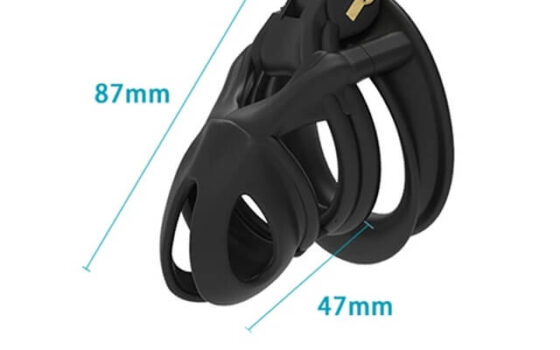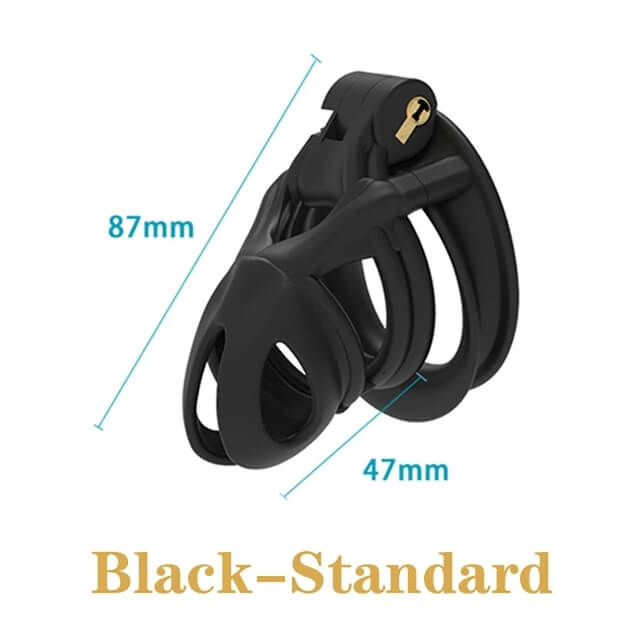
Learn to read a chastity cage size chart correctly: arrow start and end points, cage versus ring dimensions, model matching and what to ask a seller.
This guide is not medical advice. Stop use if significant pain, numbness, swelling, discoloration or circulation concerns occur.
A chastity cage size chart is only useful if you know what each line is actually measuring. Two numbers that look like duplicates often describe different things — total length versus usable internal length, ring inner diameter versus ring thickness — and ordering on the wrong one is the most common sizing mistake in this category.
This guide walks through reading the chart itself: arrows, labels, model matching and what to ask when a dimension is missing. For the body side of the equation, the measurement guide covers how to take your own numbers correctly.
Where do the measurement arrows start and end?
For cage length, check whether the arrow runs from the ring’s rear contact surface to the front tip (total assembled length) or stops at the cage’s rear opening (cage-only length). Those differ by the connector and lock height, sometimes by ten millimeters or more. Usable internal length — the space your body actually occupies — is shorter than both, and it is the number that must fit your measured length.
For rings, the arrow should span the inner opening at its widest point: that is the inner diameter the size list refers to. An arrow drawn across the ring’s metal or resin thickness is measuring the cross-section, which affects comfort but is not your size. If a chart shows both, the label usually reads ID (inner diameter) and OD (outer diameter) — order on the ID.
Which dimensions describe the cage and which describe the ring?
Keep two lists. Cage list: usable internal length, internal width or diameter at the narrowest point, total assembled length, and the gap between ring and cage rear. Ring list: inner diameter, ring thickness or cross-section, and shape (round, oval, arc). Charts that mix these on one arrow are the reason buyers receive a cage that fits the ring but crowds the tip, or vice versa.
A concrete example of a clean structure: on the Viper V7.0 EVO listing, the four included base rings are fixed sizes — 38, 43, 48 and 52 mm — while cage length is a separate choice between Nub, Nano, Small and Standard variants. Ring dimension and cage dimension live on different axes of the same order, and the chart keeps them separate. That is the layout to look for on any kit listing.
The Viper Chastity Cage V7.0 EVO
A listing whose chart separates the two axes cleanly — fixed four-ring set (38–52 mm) plus a length-variant cage: Choose the Viper V7.0 EVO for a nylon-resin kit with four base rings. One selected cage, a lock with two keys and a safety pin are included, giving you a clear starting set without buying each ring separately. Select the cage size on the product page.

Does the diagram match your selected model?
Charts are drawn per product family, but variants can differ. Confirm three matches before trusting a diagram: the model name (a V2 chart does not describe a V7 body), the variant you selected (length classes can have different internal widths), and the unit (millimeters are standard; a chart mixing mm labels with inch text deserves a second look). If the store shows one chart across several products, treat it as illustrative and ask for the specific model’s numbers.
Cross-check the chart against the variant menu. A chart that shows one length while the menu offers four is telling you the drawing is a single example, not the specification of your selection. Where the two disagree, the seller’s stated package/dimension text outranks the picture.
What should you ask when a label is missing?
Ask in writing, one dimension per question, using the standard vocabulary: “What is the usable internal length of the [variant] cage?” or “What is the inner diameter of the included rings?” Sellers answer specific questions far more reliably than “what are the sizes?” Keep the reply as your order reference.
If an answer contradicts the chart, pause rather than picking the number you prefer. Dimension conflicts between a listing’s text and its drawing are a known pattern in this category — the length guide and the diameter guide explain which number each decision should use, and how to handle a listing that never resolves the disagreement.
Trace every arrow, split cage numbers from ring numbers, match the diagram to your exact variant, and ask for missing dimensions in writing. Ten minutes with the chart prevents the most common return in this category: the right ring attached to the wrong length.
This guide includes promotional links to ChastityCage.co. To see the chart structure on current listings, browse chastity cage kits at ChastityCage.co.