A practical guide to relaxed measurement, usable internal length and the symptoms of a cage that is too long, too short or mismatched in shape.
This guide is not medical advice. Stop use if significant pain, numbness, swelling, discoloration or circulation concerns occur.
Length labels appear precise, but sellers may measure from the lock, the outside edge or the internal base. A 60 mm product can therefore offer less—or occasionally more—usable space than another product with the same headline number.
Measure first with the complete sizing method, then compare the exact geometry rather than shopping by a single number.
Measure natural relaxed length
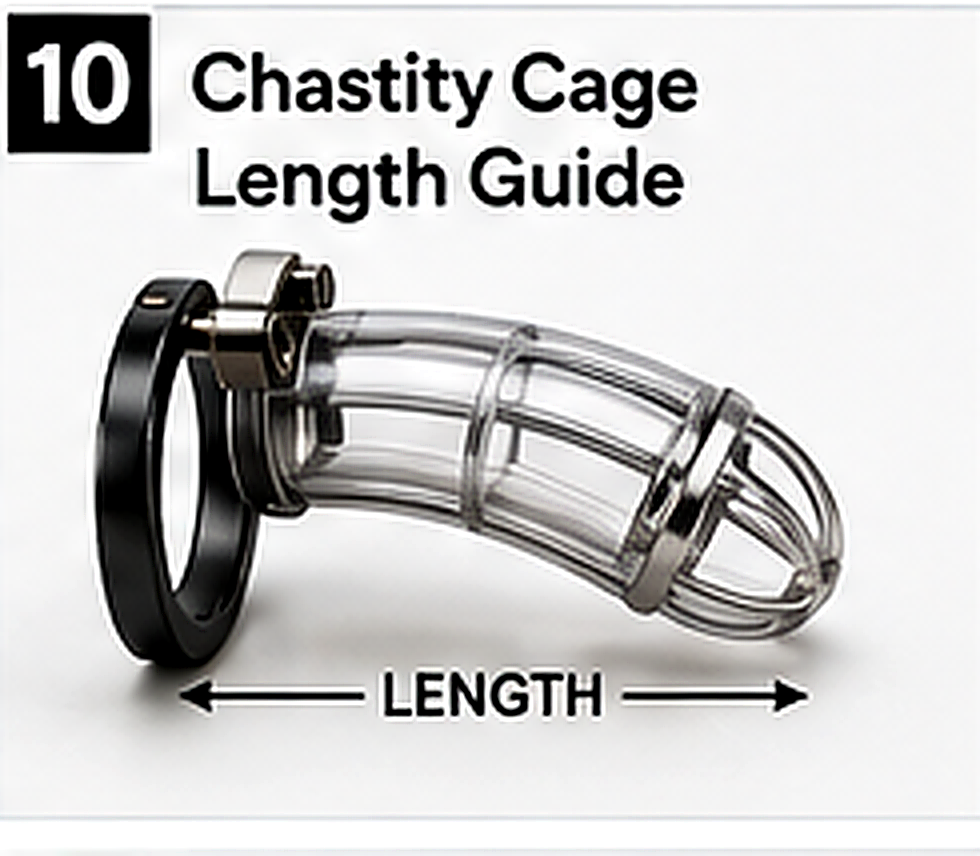
Stand normally in a comfortable room and measure along the top from the body-side base to the tip. Do not stretch forward and do not measure during arousal. Repeat on different occasions and record a range, because temperature and tension affect resting size.
This is a fitting input, not a verdict. Curvature, internal width, front shape and the position of the ring change how much of that length can sit comfortably inside a device.
Ask what the product number means
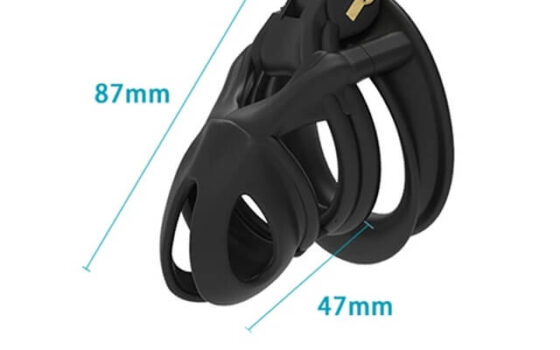
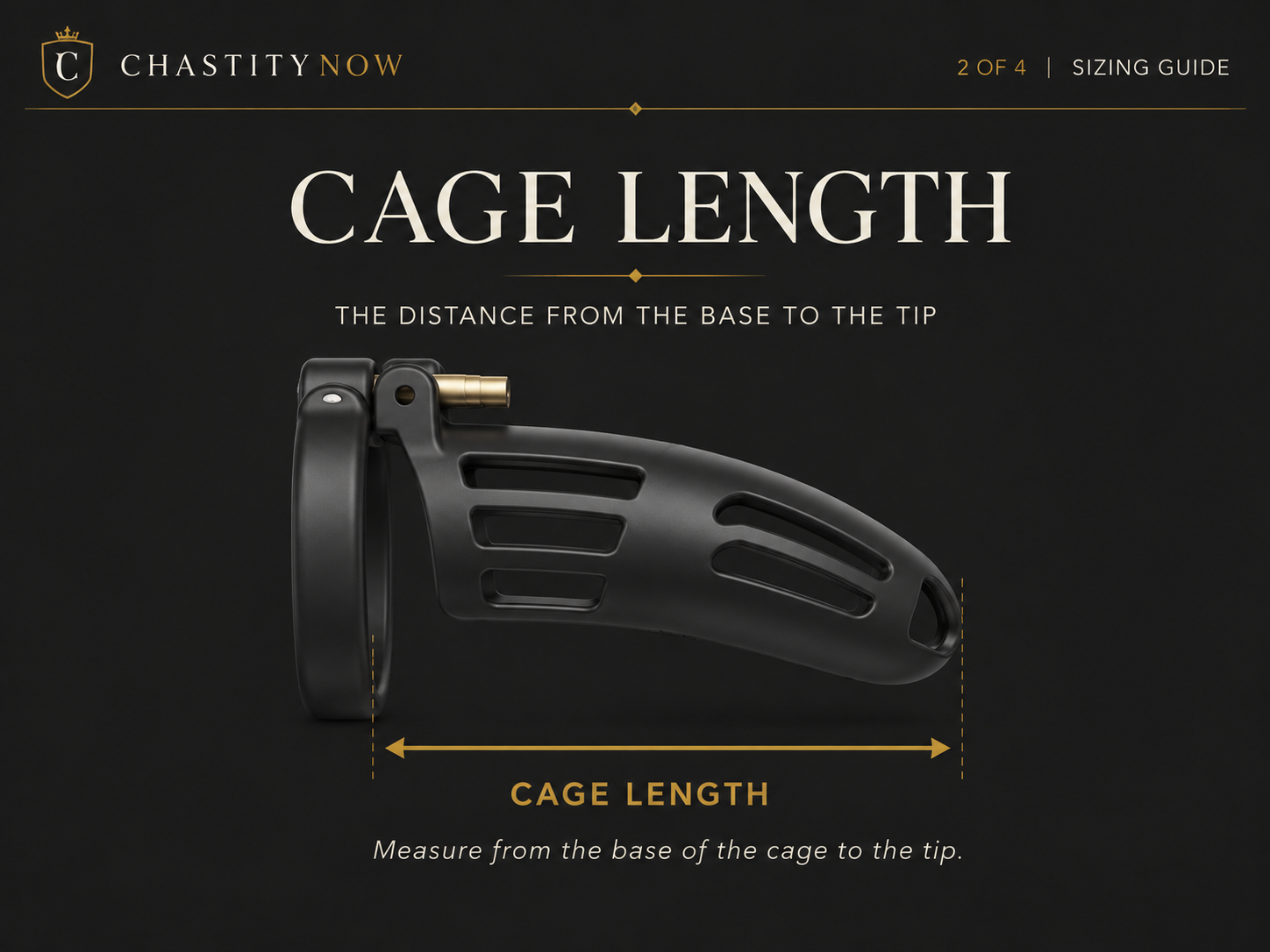
Look for a technical drawing that identifies usable internal length. If a listing gives only “total length,” confirm whether the lock and connector are included. Curved designs should be measured along the internal path, not as a straight exterior line.
Also check whether the rear begins at the ring plane or in front of a built-in gap. Product language is inconsistent enough that a dimension without a diagram should be treated cautiously.
How excess length behaves
A cage with more forward room may allow shifting and partial growth before the body reaches the front. That movement can create leverage, pull the base ring forward and increase rubbing under clothing. The outline may also be more visible.
These symptoms do not always mean the ring is too large. Review length, weight and support before changing to a tighter ring.
How insufficient length behaves
A cage that is too short for its shape can cause tip pressure, folding, pinching at openings or difficulty positioning the body completely inside. Strong compression can also make the front opening hard to align for bathroom use.
Do not treat pain during arousal as proof that a short cage is “working.” Persistent or sharp pressure means the geometry needs reassessment.
Short, micro and flat are different concepts
A short cage reduces forward internal length. A micro cage is a more extreme short format. A flat cage changes profile to sit closer to the body, sometimes by combining short length with a wide or curved front. An inverted design redirects space inward. These labels are not interchangeable.
Profile decisions belong after basic fit is understood. The dedicated flat chastity cage guide covers discretion and daily-wear trade-offs.
Use the complete fit test
- Compare your relaxed range with the stated usable internal length.
- Check width and curvature at the same time.
- Fit the device unlocked without stretching or forcing tissue.
- Stand, sit, walk and bend.
- Use the bathroom and inspect alignment.
- Remove and check the skin.
Judge the full assembly with the ring, gap and movement checklist.
A practical interpretation table
| Observation | What to review |
|---|---|
| Empty forward space and swinging | Usable length, weight and support |
| Tip pushed firmly into the front at rest | Length, curvature and internal width |
| Body must be stretched to enter | Cage is not matching relaxed geometry |
| Front opening repeatedly misaligns | Length, shape, width and device position |
| Good standing fit but chair pinch | Gap, curvature and ring angle |
Length must be read with width and curve
Two cages with the same usable length can position the body differently if one is straight and narrow while the other is curved and wider. A short number is not meaningful without the shape that contains it.
Front design also matters. A rounded end, flat plate and angled opening distribute contact differently. Technical drawings and an unlocked fitting are more informative than a “micro,” “standard” or “long” label.
Do not optimize for arousal pressure
The cage may limit expansion, but choosing length to create maximum pain during arousal is unsafe. A suitable device maintains normal circulation and a workable routine. If nighttime or repeated arousal creates growing pressure, unlock and reassess rather than waiting to adapt.
Use the Fit & Comfort library to move between whole-device diagnosis and component-specific checks.
Technical references
- HolyTrainer design specifications — demonstrates the difference between multiple tube-length measurements and internal diameter.
- KINK3D sizing guidance — supports repeated relaxed-length measurement under normal conditions.
These are manufacturer-specific examples, not universal formulas. Always compare your measurement with the exact drawing and terminology for the device being considered.
Choose usable space, not a label
Appropriate cage length is enough usable space for a natural relaxed fit without unnecessary forward movement. Confirm what the product measures, account for shape and width, and let an unlocked routine test overrule the marketing label.
Internal and External Cage Length: Add a Labelled Example
The two length figures deserve labels on a real listing. External (total assembled) length: everything from the ring’s rear face to the cage’s front tip — hardware included, useful for clothing-profile planning, useless for fitting. Internal (usable) length: the space available to the body inside the cage — the fitting number, always smaller, always the one your measurement compares against. The Viper V7.0 EVO listing shows the pattern cleanly: its length classes (Nub through Standard) are internal-space choices, while any product photo’s tip-to-ring span is an external figure that varies with the ring and lock installed.
Order on internal, plan outfits on external, and label every figure you write down with which one it is. A note that reads “62 mm” explains nothing in six months; “62 mm external, Small class, internal per chart” explains everything.
The Viper Chastity Cage V7.0 EVO
Choose the Viper V7.0 EVO for a nylon-resin kit with four base rings. One selected cage, a lock with two keys and a safety pin are included, giving you a clear starting set without buying each ring separately. Select the cage size on the product page.