Circular and butterfly front plates shape a flat cage's comfort and discretion differently. Compare width, openings and lock profile before choosing.
This guide is not medical advice. Stop use if significant pain, numbness, swelling, discoloration or circulation concerns occur.
Once you narrow your search to flat chastity cages, a second difference appears immediately: the shape of the front plate. Circular plates dominate the category, but butterfly-shaped fronts have become a recognizable alternative — and the shape changes more than the look. It moves the openings, the lock position and the way the plate meets your body when seated.
This guide compares the two plate shapes on dimensions you can verify from listings, using the Flat Gatling (circular) and the Butterfly Flat (butterfly) as the examples. For what “flat” means overall, start with the flat-cage guide.
How wide is the complete front plate?
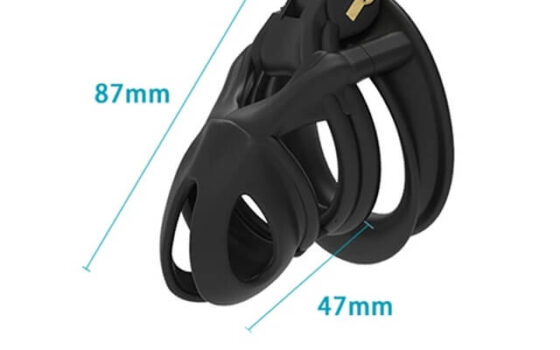
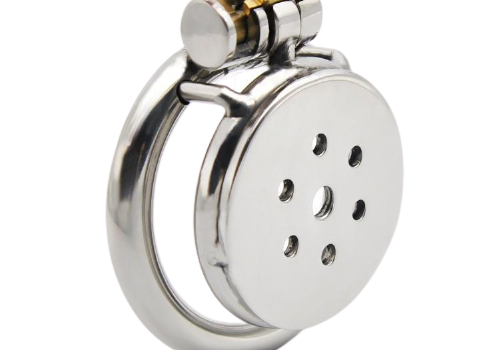
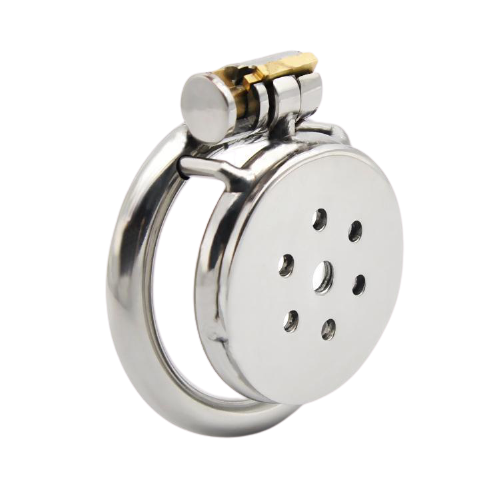
Plate width is the dimension that decides discretion under fitted clothing — wider than the body it covers means the outline grows sideways even as the forward profile stays low. Circular plates state their diameter; the Flat Gatling’s round face is the standard reference. Butterfly plates trade round width for sculpted edges: the Butterfly Flat’s wing shape cuts width at the top and bottom while keeping the central mass, so its “width” is not one number but a shape — read the widest point and the height at the lock.
When comparing the two, use the widest stated dimension of each plate and the side-view depth. A circular plate at width X and a butterfly plate at the same X do not present the same silhouette — the butterfly’s narrower wings can sit flatter against the body’s contours at the top and bottom edges.
Where are the openings and attachment points?
Openings do two jobs: urination alignment at the front tip, and ventilation across the face. Circular plates usually center the front opening and ring the face with perforations — the Gatling’s perforated circle is the pattern. Butterfly plates move openings into the wing structure, which can align the front opening slightly off the plate’s visual center; verify the urination opening’s position against your anatomy rather than assuming the plate’s symmetry is the opening’s symmetry.
Attachment points matter at the rear: where the plate meets the ring connector, and whether the plate’s lower edge or the connector carries the seated pressure. On butterfly designs the connector often sits between the wings, which can change where the assembly loads the ring when you sit — a small geometric difference with real comfort consequences over a workday.
The Flat Gatling Chastity Cage
The circular-plate example: The Flat Gatling is a stainless-steel option with a circular front plate and a compact flat profile. Choose it for this particular shape rather than treating every flat cage as the same design. Open the product page to select the cage and ring options.

Where does the lock sit in profile?
The lock is usually the tallest point of a flat cage’s profile. On circular plates, the lock typically sits at the center or top edge, adding a compact bump inside the plate’s footprint. On butterfly plates, the lock frequently nests between the wings — the Butterfly Flat’s design uses that central valley — which can lower the effective profile at the cost of putting metal exactly where a belt line or waistband may cross.
Check the lock’s projection in millimeters if stated, and if not, ask or study the side-view photo. Then test with your actual clothing: the plate shape that looks lower in product photos can end up taller on your body depending on where the lock lands relative to your waistband. The lesson from the flat-versus-standard comparison applies here too — profile is measured worn, not photographed.
Which photos make a useful side-by-side comparison?
Ask for (or screenshot) three angles of each candidate: front face (plate shape and openings), side profile with the lock fitted (true height), and rear quarter (connector and ring attachment). Put the two products’ photos at the same scale side by side — the store’s white-background images usually share scale if both come from the same store — and mark the widest point and tallest point on each.
Then replace the photos with numbers wherever listings state them: widest plate dimension, stated weight, ring options included. The Flat Gatling page offers cage and ring selections without publishing a full package list; the Butterfly Flat states a 304 stainless build at a stated 133 g with one selected ring and an optional belt. Different documentation depth is itself data — the listing that states more lets you verify more before paying.
Butterfly Flat Chastity Cage
The butterfly-plate example, with stated material and weight: The Butterfly Flat pairs a distinctive butterfly-shaped front with a stainless-steel construction. The package lists one cage, one selected ring and a lock with two keys; a belt is optional. Choose this design when you prefer its outline, then select your ring and belt configuration.

Circular spreads, butterfly sculpts. Compare plate width at the widest point, opening positions against your anatomy, and lock height in side profile — then buy the plate whose geometry your clothing and routine actually hide. The shape is the last mile of flat discretion; the chart, not the product render, gets you there.
This guide includes promotional links to ChastityCage.co. To compare both plate shapes, browse flat chastity cages at ChastityCage.co.