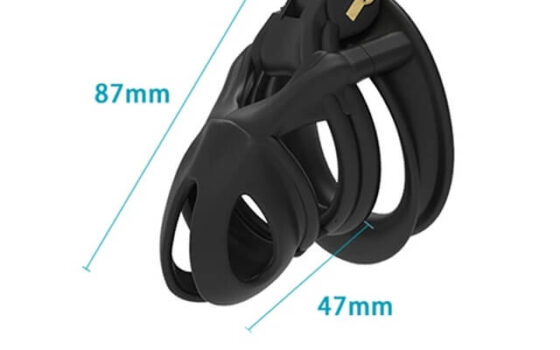
A base-ring construction comparison that avoids declaring either design universally more comfortable.
This guide is not medical advice. Stop use if significant pain, numbness, swelling, discoloration or circulation concerns occur.
The same labelled diameter can feel different across ring shape, cross-section and angle. Compare the complete geometry before attributing comfort to the hinge alone.
Hinged and solid rings at a glance
| Criterion | Hinged or split ring | Solid ring |
|---|---|---|
| Setup | Opens around the body | Requires passing the body through the ring |
| Pinch points | Hinge and closure need clearance | No hinge, but connector still matters |
| Movement | Joint play may change contact | Continuous geometry is more stable |
| Bulk | Mechanism can project | Often simpler profile |
| Removal | May open more directly | Depends on passing back through safely |
Start with the routine, not the label
Choose based on the wearer’s setup ability, mobility, hair and skin clearance, plus the settings in which removal may be needed. Practice assembly and release off the body first.
Fit can reverse the apparent advantage
A hinge does not correct diameter, shape or gap. A solid ring does not guarantee even pressure. Test the full circumference and the way the cage connector changes ring angle.
Cleaning depends on reachable surfaces
Hinges and closures add joints that need washing, drying and inspection. Solid rings are simpler but still require attention at coatings, welds and connectors.
A practical shortlist test
Operate the ring repeatedly off the body, inspect gaps and sharp movement, then run a short unlocked fitting. Reject any design that traps skin or hair during normal closure.
Avoid the common shortcut
Do not use a hinge to close around tissue that cannot comfortably fit the chosen diameter. Easier installation is not permission to select a constricting ring.
Verify the complete product evidence
Look for internal rather than exterior dimensions, the assembled weight, the narrowest usable space, ring and gap options, exact material, care instructions and a clear removal method. Product photos can show shape but rarely prove scale, finish or daily fit. When a listing omits a decision-critical fact, ask the seller or remove that design from the shortlist instead of filling the gap with an assumption.
Use the first tests to challenge the choice
Assemble and unlock the device off the body, then run an unlocked fit and short waking session. Include sitting, walking, bathroom alignment, cleaning and complete removal. The purpose is to look for reasons the design may not suit the wearer, not to confirm a purchase emotionally. Record pressure, movement, noise, drying and skin recovery. Only a repeatable, uneventful result supports another test.
Check support, returns and replacement parts
Read hygiene-related return limits before body contact and confirm whether rings, spacers, locks or other fit-critical parts are available separately. Clear technical support can matter more than a long feature list. Photograph a manufacturing defect before attempting any repair, and do not modify an unknown material or locking component while it is worn.
Continue with the relevant ChastityNow guides
The bottom line
Hinged rings trade simpler entry for added mechanisms; solid rings trade mechanical simplicity for a more involved fit. Pick the geometry that stays smooth, stable and easy to remove.
This article belongs to the Chastity Cages library, where the surrounding guides cover the wider topic.
What to Check in a Hinged-Ring Listing
A hinged-ring listing earns trust through four details. Closure hardware: what the hinge and latch are made of, and whether the listing states they close flush. Pinch geometry: where the two halves meet, and whether the seam sits on a contact path. Size labeling: whether the stated diameter is the closed-ring inner diameter (it must be — an open hinge inflates apparent size). And serviceability: whether the maker supplies replacement hinge pins.
Test the closure off-body, twenty cycles, before first wear: a hinge that gapes or resists at cycle fifteen will not improve on the body. Solid-ring readers get a simpler checklist — no mechanism, just sizing — which is exactly why a fixed multi-ring kit (the Viper’s four solid sizes, for example) remains the low-maintenance comparison point for hinged designs. Hinges buy convenience; solids buy absence of mechanism. Both are honest purchases when the listing documents which one you’re getting.