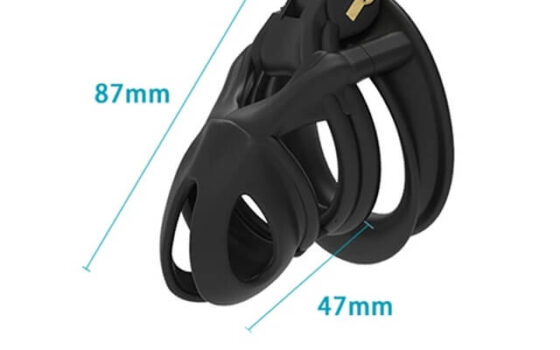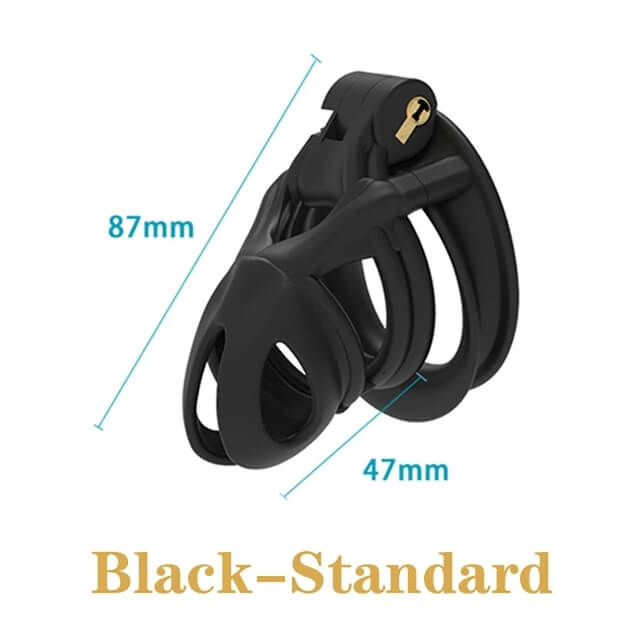
A first chastity cage with a clear size chart: labeled internal dimensions, ring and cage rows kept separate, diagrams matched to variants — shortlist on clarity.
This guide is not medical advice. Stop use if significant pain, numbness, swelling, discoloration or circulation concerns occur.
Your first cage order will be placed against a size chart, so the chart is part of the product. A listing whose chart labels its arrows, splits ring figures from cage figures and matches its diagram to each variant is a listing you can order from confidently. A listing with a pretty render and unstated numbers is a guess with a checkout button.
This guide defines what a clear chart looks like, how ring and cage choices appear on honest ones, and how to shortlist listings you can actually compare. The reading method itself is documented in the size-chart guide; this page applies it to first-purchase shortlisting.
Look for labeled internal dimensions
The minimum clear chart states usable internal length and internal width with their units, and marks where each arrow starts and ends. Total assembled length may appear too — useful for clothing, irrelevant for fitting — but the internal figures are the ones your measurement meets. If a chart shows one arrow without labels, or states numbers without saying what they measure, the listing is asking you to assume.
A clear chart also survives the variant question: the numbers shown belong to a stated configuration, and the listing says how other variants differ. That is the difference between documentation and illustration.
Check ring and cage choices separately
Honest charts keep two axes apart: ring inner diameters listed as their own row (or their own menu), cage dimensions as another. Kits make this easy — a four-ring kit’s chart shows the included sizes as a set, separate from the length classes. If a listing folds ring numbers into cage numbers, or offers “sizes” without saying which axis they size, ask before ordering; the two decisions are independent and each needs its own figure.
Your first order benefits doubly from the separation: ring range answers your fitting uncertainty, cage dimensions answer your length question, and a chart that keeps them apart lets you solve each with the right measurement.
Match the diagram to the selected option
A clear chart belongs to a stated variant. When a listing offers four length classes under one drawing, the drawing documents one of them — find out which, and how the others differ. The best listings provide a chart per variant or a table with a row each; the acceptable minimum is a stated answer to “which variant is pictured, and what are the other variants’ internal lengths?”
Diagram-to-option matching is also your unboxing check: the chart you ordered against becomes the chart you verify against. Keep a screenshot with the order record; charts change, screenshots do not.
The Viper Chastity Cage V7.0 EVO
The chart style this guide shortlists: The Viper V7.0 EVO listing shows the clear-chart pattern: four included rings stated at 38/43/48/52 mm, length classes (Nub to Standard) as separate selectable rows, and a diagram tied to its stated configuration. Check: confirm the pictured variant’s internal length is the one your measurement needs.

Shortlist listings you can actually compare
Build the first shortlist from chart quality before price or appearance: candidates whose internal dimensions, ring figures and variant mapping are all stated. A shortlist of two well-documented listings compares cleanly; a shortlist containing one clear chart and one guess cannot produce a comparison at all — it produces a coin flip wearing a research costume.
Then run your measured numbers down each candidate’s rows and buy where they fit. The clear chart was never the prettiest part of the listing — it is the part that lets a first order be a decision instead of a hope.
Flat & Small Chastity Cage Set
And the set whose package list reads like a chart: The Flat & Small Set documents its contents — two bodies, three rings, two keys, belt — so the chart comparison extends to the package row, not just dimensions. Check: stated contents are also chart data; count the box against them on arrival.

Labeled dimensions, separated axes, variant-matched diagrams: three checks that turn size charts from decoration into decision tools. Shortlist the listings that document themselves, run your numbers down their rows, and let the clearest chart — not the loudest listing — take your first order.
This guide includes promotional links to ChastityCage.co. To shortlist clearly documented kits, browse chastity cage kits at ChastityCage.co.
Related ChastityNow guides
- How to read a chastity cage size chart
- Choosing your first chastity cage