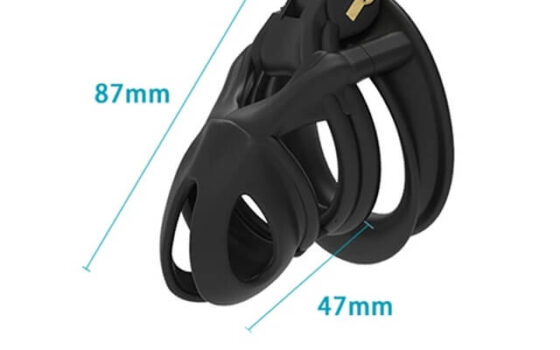
A careful comparison of manufacturing method and material, with practical checks for finish, dimensions, cleaning and support.
This guide is not medical advice. Stop use if significant pain, numbness, swelling, discoloration or circulation concerns occur.
A seller may use “3D printed,” “nylon,” “PA12,” “resin” or “molded plastic” inconsistently. The first job is to identify what the listing actually states. If the method, material or post-processing is unclear, weight and skin-contact suitability cannot be inferred from appearance.
3D-Printed vs Resin Cages at a Glance
| Question | 3D-printed label | Resin label |
|---|---|---|
| What it tells you | A production method only | A broad material description |
| Finish | Depends on process and post-processing | Depends on formulation and finishing |
| Weight | Requires a complete-device figure | Requires a complete-device figure |
| Fit | Requires internal dimensions and tolerances | Requires the same evidence |
Manufacturing Method and Material Are Not the Same Thing
Powder-bed nylon, filament printing and light-cured resin printing produce different surfaces and properties. “Printed” alone does not identify the polymer.
Ask for the exact material wording and production method. Do not convert a vague store category into a body-safety or durability claim.
Surface Finish and Edge Quality
Inspect openings, seams, layer texture, ring edges, connector points and lock recesses. A polished photo cannot prove how hidden surfaces feel.
Any sharp edge, crack, uncured-looking residue or rough area is a reason not to wear the device. Do not sand or coat an unknown material while it is in use.
Weight and Bulk
Neither printing nor resin guarantees a lighter cage. Wall thickness, ring, lock and hardware determine complete weight and leverage.
Use an assembled weight for the exact variant. If none is published, keep weight unresolved rather than replacing it with a material stereotype.
Sizing Tolerance and Available Geometry
Digital manufacturing can offer many sizes, but availability does not prove tolerance or fit. Compare internal length and width, ring, gap, angle and connector.
Clarify whether listed measurements are nominal, internal or external and whether parts from different sizes are compatible.
Cleaning, Moisture and Inspection
Openings and reachable surfaces matter more than a broad material label. Follow the maker’s care method and confirm the surface remains intact after cleaning.
Remove for full inspection. Do not assume a printed texture or resin surface is non-porous, chemical-resistant or suitable for prolonged contact without evidence.
Repair, Replacement and Durability Questions
Ask whether rings, spacers, locks and cage bodies can be replaced separately and how defects are handled. Do not invent a lifespan.
A crack, deformation or failed connector ends use until the device is professionally clarified or replaced. Home repair can change fit and lock behaviour.
Which Questions Should You Ask Before Choosing?
- What exact material and process are used?
- How is the part finished and quality-checked?
- Which dimensions are internal and variant-specific?
- What is the assembled weight?
- Which care instructions and contact limits are documented?
- Are replacement parts and returns available?
Related ChastityNow guides
- Comparisons library
- the fit guide
- the cage-types overview
- plastic and resin cage guidance
- the material comparison
Buy the Evidence, Not the Label
The useful comparison begins only after method and material are separated. Require exact dimensions, finish, care and replacement evidence for the chosen variant.
3D-Printed Is a Process, Not a Material Name
One vocabulary correction improves every listing read in this comparison: “3D-printed” describes how a part was made; “resin” names a family of materials, some printed, some cast. A molded resin cage (the Viper kit’s nylon-resin body, for example) and a printed-resin cage share a material word and differ in process — and process is where the practical differences live: layer lines, seam placement, dimensional repeatability, post-processing quality.
When a listing says only “resin,” ask which process and which resin — the answer changes the inspection checklist (layer junctions versus mold seams) and the care conversation (post-processing chemistry versus molding-agent residue). And when it says “3D-printed” as if the phrase certified quality, remember the process is neutral: excellent prints and terrible prints both exist, and the listing’s finish photos are the evidence that decides which one ships.
The Viper Chastity Cage V7.0 EVO
Choose the Viper V7.0 EVO for a nylon-resin kit with four base rings. One selected cage, a lock with two keys and a safety pin are included, giving you a clear starting set without buying each ring separately. Select the cage size on the product page.