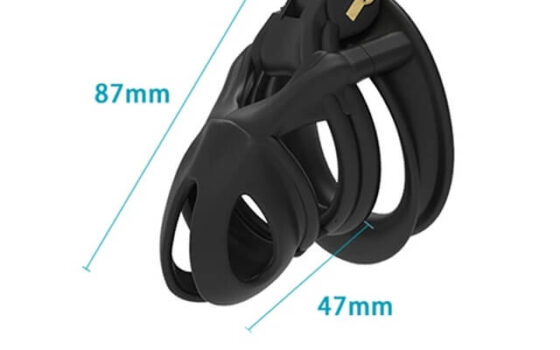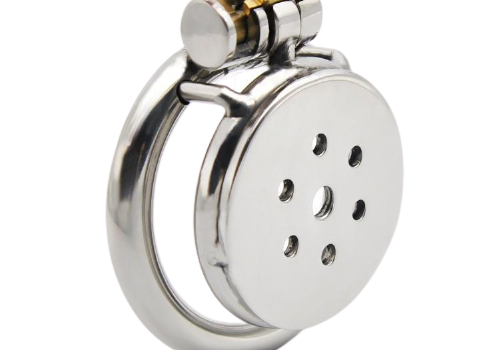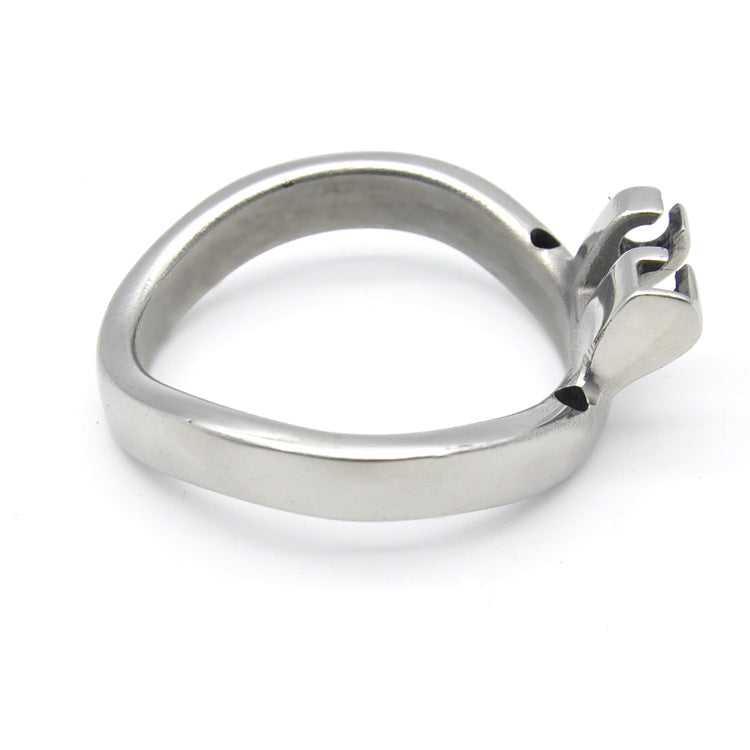
Round, oval and arc chastity rings fit differently at the same size. Compare shape with the connection point, not just the inner diameter.
This guide is not medical advice. Stop use if significant pain, numbness, swelling, discoloration or circulation concerns occur.
Two rings with the same inner diameter can fit completely differently, because shape decides where the opening is wide, where it is narrow and how the ring meets the cage connector. Round, oval and arc are the three shapes you will meet in listings, and each interacts differently with the same measured size.
This guide compares the three shapes on the dimensions you can actually verify, and shows what changes at the connection point where ring meets cage. For measuring the size itself, see the ring-size guide; for the solid-versus-hinged question, the dedicated comparison covers it.
How are round, oval and arc used in listings?
Round rings are the default: a circular opening with one diameter everywhere, listed as that single number. Oval rings stretch the opening along one axis, so a listing may show two figures — internal width and height — or a single “equivalent” diameter with the oval noted in the fine print. Arc rings curve to follow the lower body’s contour: the metal sits closer to the body at the front and rises toward the connector, and listings usually give one inner diameter plus the arc description.
The vocabulary is loose across the market — “ergonomic” often means arc, “anatomical” often means oval — so trust the shape you can see in the product photo over the adjective. The photo also shows the connector style, which matters more than any name.
Which dimensions can you compare fairly?
Compare like with like: a round ring’s inner diameter against another round ring’s. When an oval enters the comparison, compare its narrow axis to your measurement’s critical dimension, because that is where the fit binds. An arc ring’s stated diameter refers to its opening size, but its effective fit also depends on how far the arc stands off the body — a dimension listings rarely state. Mark that as unknown rather than assuming.
Be explicit about units and take the stated millimeters at face value only when the chart labels them. A “45 mm arc” and a “45 mm round” are the same opening size on paper and different objects on the body — the shape changes pressure distribution, contact area and how the ring behaves when you sit.
What changes at the cage connection?
The ring is half of a mechanical joint: its connector pins, spacers and locking post must match the cage body’s receiver. Round-kit rings (like the four included with a multi-ring resin kit) share one connector standard across their set, which is what lets you swap sizes freely inside that kit. An arc replacement ring built for a different product family may have a different pin spacing, receiver width or locking-post height — the shapes can even look interchangeable in photos while the hardware is not.
That is why shape comparisons happen with the connection in view. When evaluating a replacement ring, the questions are: does its connector match your cage’s receiver exactly, and does the arc’s standoff change your assembled gap — the distance between ring and cage rear? A beautiful arc that alters the gap changes the whole assembly’s fit, not just the ring.
Replacement Arc Ring
An arc ring sold as itself — a standalone replacement in three stated sizes, no cage included: The Replacement Arc Ring is sold separately in listed 40, 45 and 50 mm options. Choose it when you need a ring rather than another complete cage kit. Match the exact cage connection and size first; an arc shape alone does not establish compatibility with another model.

What should a ring comparison photo show?
Three shots settle any comparison: the ring alone from above (showing the true opening shape), the ring beside a ruler or with its stated dimensions visible (anchoring the size), and the ring attached to its intended cage (proving the connection). A photo of a ring floating in a styled scene proves nothing about shape, size or fit.
When a listing shows only one of the three, ask for the others — “a straight-on photo of the ring opening” is a reasonable request any seller can fulfill in a minute. Your own comparison photos should follow the same rule: straight-on, with a scale reference, and one shot of the full assembly. That is the record that makes the next ring decision easy.
The Viper Chastity Cage V7.0 EVO
And the round-ring alternative inside a complete kit, where all four rings share one connector standard: Choose the Viper V7.0 EVO for a nylon-resin kit with four base rings. One selected cage, a lock with two keys and a safety pin are included, giving you a clear starting set without buying each ring separately. Select the cage size on the product page.

Shape is a real fit variable, not a style choice. Compare rings by opening size and connection hardware, photograph them straight-on with scale, and remember that a 45 mm arc and a 45 mm round ring are different objects on the body. Choose the shape that matches your cage’s joint — then choose the size.
This guide includes promotional links to ChastityCage.co. To compare ring shapes on current listings, browse chastity cage kits at ChastityCage.co.