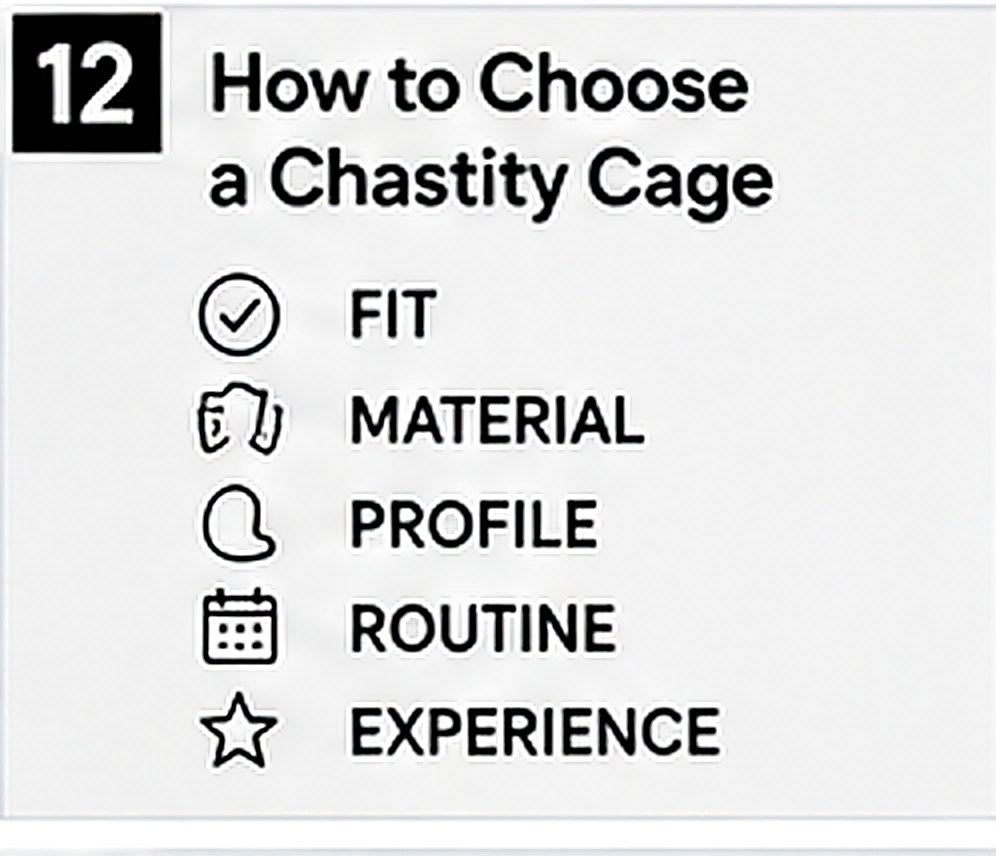
A criteria-led decision guide for comparing chastity cages without turning the choice into a product ranking or category sales page.
This guide is not medical advice. Stop use if significant pain, numbness, swelling, discoloration or circulation concerns occur.
There is no universally “best” cage because the decision combines anatomy, tolerance, environment and the meaning of the practice. A heavy open metal design and a light enclosed resin design can both be reasonable for different people—and both can fail when dimensions are wrong.
Use the types overview to learn the vocabulary. Then apply the filters below before looking at brand claims.
1. Fit: require usable dimensions
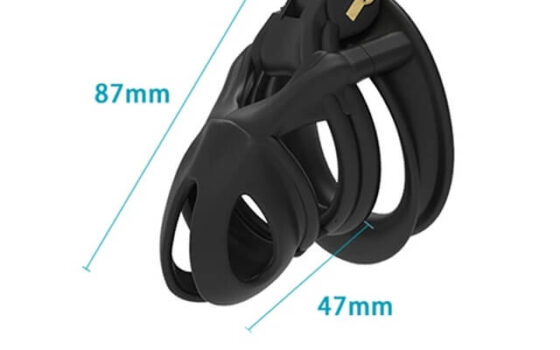
Collect base-ring internal size and shape, cage usable internal length, internal width or height, and ring-to-cage gap. Compare them with repeated relaxed measurements. A seller should distinguish internal space from exterior length and explain how a curved design is measured.
If dimensions are incomplete, do not let reviews substitute for them. The complete fit guide shows how the full assembly should behave after arrival.
2. Material: compare feel and maintenance
Rigid metal is durable and often open enough to rinse, but its weight and thermal feel are part of daily wear. Plastic and resin can be light and closely contoured; surface finish, seam quality and heat/chemical limits matter. Silicone is flexible and softer at contact points but may move more and require careful drying.
Do not accept vague “body-safe” claims as complete material information. Look for a specific material, care instructions and a finish you can inspect.
3. Profile: design for real clothing
Standard cages project forward. Short and micro cages reduce internal length. Flat designs aim to reduce the visible outline, while inverted designs redirect space more aggressively. Open bars increase airflow; enclosed bodies create a smoother outside surface.
Choose the least specialized profile that solves the actual problem. A beginner who wants discretion may do better with a modest contoured design than the smallest flat device available.
4. Routine: name the hardest ordinary task
Will the cage be used only at home, during sleep, under work clothing or while traveling? Each setting changes priorities. Work emphasizes quiet hardware, stable movement and privacy. Sleep exposes nocturnal pressure. Repeated wear increases the value of ventilation, full removal and easy cleaning.
Do not buy for an imagined permanent routine before a short daytime test has succeeded.
5. Lock and removal: simplicity wins
Confirm how the device unlocks, whether spare keys exist and what happens if a barrel lock jams. Electronic features add charging, app, account and connectivity dependencies. They may be enjoyable, but emergency removal should not depend on a remote server or a partner responding.
For partnered use, normal keyholding and emergency access can be separate. Both should be agreed before locking.
6. Construction: inspect contact points
- Edges and vents are smooth.
- Welds, print layers or molded seams do not meet skin sharply.
- Hinges close without trapping.
- Pins align without force.
- The lock does not protrude into a contact zone.
- All parts can be washed and dried as instructed.
A decision matrix
| Question | Favor | Avoid assuming |
|---|---|---|
| Still learning size? | Multiple ring/gap options | One fixed size will “break in” |
| Need easy cleaning? | Open access and full removal | Vent holes clean themselves |
| Need discretion? | Stable contour and clothing test | Shortest always hides best |
| Sensitive to pull? | Manageable weight and support | Tighter ring solves weight |
| Partner holds key? | Separate emergency method | Consent ends at the click |
Before you keep it
Inspect on arrival, assemble repeatedly and test unlocked. Walk, sit, bend and use the bathroom. Check the return window before extended skin contact. If the device cannot be cleaned or removed predictably, it has failed the selection test even if the style is appealing.
Beginners can use the beginner-friendly feature guide to narrow the framework further.
Non-negotiable removal rule: A device should never cause sharp pain, numbness, increasing swelling, unusual discoloration or coldness, broken skin, trapped tissue or difficulty urinating. Remove it promptly and seek medical care for severe or persistent symptoms. Do not use a smaller ring or cage to compensate for poor security.
Build a shortlist before looking at products
Write non-negotiables under six headings: fit data, material, profile, cleaning, lock and routine. Eliminate any device that cannot answer a non-negotiable. Only then compare appearance or price. This reverses the common process of falling for a design and rationalizing missing evidence.
A useful shortlist may contain devices from different material families. The comparison should explain why each one survives the same criteria.
Price does not remove the fit process
Custom or premium construction may improve dimensions and finish, but it cannot replace body measurement, movement tests or consent. Budget designs can also be usable when accurately specified and well finished. Judge evidence, not prestige.
For the wider device landscape, continue through the Chastity Cages library.
The six-part decision matrix
| Decision layer | Question that eliminates weak options | Evidence to request |
|---|---|---|
| Fit | Are all usable internal dimensions stated? | Technical drawing, ring/gap choices |
| Material | Is the exact material or coating identified? | Maker specification and care limits |
| Profile | Will the full assembly work with clothing and posture? | Side dimensions and assembled weight |
| Routine | Can you sit, walk, urinate and remove it where intended? | First-hand fit test, not review averages |
| Cleaning | Can every contact area be washed, rinsed, dried and inspected? | Disassembly and care instructions |
| Removal | Can normal and emergency unlocking remain predictable? | Working keys, spares and maker support |
If this is your first device rather than an upgrade, the first-cage guide narrows this framework to a beginner’s purchase, and the types overview classifies the available designs.
Make the decision from evidence
Good cage selection is evidence-led: dimensions, material, profile, routine, construction and removal. Follow that order and the market becomes easier to navigate. The right choice is not the most restrictive cage; it is the one that fits the agreed use without asking you to ignore the body.
Do Colour Options Change the Kit? Check the Actual Listing
Color rows look decorative and usually are — but “usually” is doing work in that sentence. The honest check is one line: does the package list differ between colorways? On well-run listings, Pink and Black variants of the same set contain identical parts (the Flat & Small Set states this explicitly: separate color choices, same contents). On sloppy ones, a color variant can map to a different ring count or a different photo library entirely.
Verify by variant, not by assumption: select each color at checkout and watch whether the price, the options or the package description change alongside. Identical rows mean your choice is aesthetic, and you should enjoy it as such. Divergent rows mean “color” was carrying a hardware difference, and the listing owes you a clearer label.
One related note: gallery photos often show only one colorway assembled. Judge structure from any variant’s photos — geometry is shared — but order against the written list of the color you chose.
Flat & Small Chastity Cage Set
The Flat & Small Set includes two cage shapes, three rings, two keys and an adjustable support belt. Choose it when you would rather compare a flat and a small shape within one package than order two separate kits. Pink and Black are separate color choices.

Recommended Kits by Need: Four Rings, Two Shapes or Steel Flat
Recommendations by need, from documented kits only. Still settling ring size: a four-ring kit — the Viper V7.0 EVO’s stated 38/43/48/52 mm set brackets the common range inside one order. Comparing silhouettes before committing: a dual-shape set — the Flat & Small Set’s two bodies on shared rings answers flat-versus-small in one purchase. Committed to flat with a known ring size: a steel flat design — the Butterfly Flat’s stated 133 g 304 stainless build with its 40–55 mm ring menu.
Three needs, three kits, no “best overall” — this page deliberately declines to rank, because the honest ranking variable is the reader’s own measurement and routine, which no listing knows. Use the framework sections above to name your need; the three recommendations above are where each named need currently lands on documented evidence. When your need is named and your numbers are in hand, the recommendation reads itself.