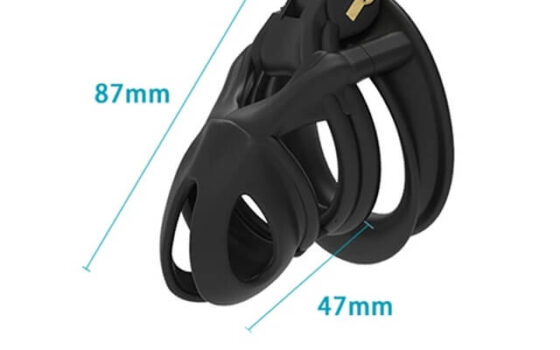
A low-profile selection guide covering projection, width, hardware, noise and clothing without duplicating the flat-cage type guide.
This guide is not medical advice. Stop use if significant pain, numbness, swelling, discoloration or circulation concerns occur.
Product photos usually show the cage body alone. Clothing meets the whole assembly and changes with sitting, walking and bending.
What improves or undermines discretion
| Criterion | Lower-profile evidence | Potential visibility |
|---|---|---|
| Projection | Short, body-following curve | Long forward lever |
| Width | Controlled side profile | Wide plate or bulky connector |
| Lock | Integrated or shielded hardware | Loose padlock or projecting barrel |
| Movement | Stable with suitable support | Swinging, rotation or frequent adjustment |
| Sound | Quiet joints and secure lock | Clicking metal or loose components |
Start with the routine, not the label
Test the exact underwear and trousers while standing, seated and walking. Discretion also means normal bathroom access and no need for public adjustment.
Fit can reverse the apparent advantage
Do not compress an unsuitable design with tight clothing. The cage must first fit safely; garments can stabilize but should not create pressure or hide warning signs.
Cleaning depends on reachable surfaces
Low profile often reduces open space. Confirm that compact geometry still allows washing, drying and full inspection rather than trading visibility for trapped moisture.
A practical shortlist test
Measure the whole assembly from front and side, check the lock and hinge, listen during movement and test common clothing at home. Reject designs that require constant concealment tactics.
Avoid the common shortcut
Do not treat “micro,” “flat” or “stealth” as proof of discretion or comfort. Those labels do not reveal internal fit, side width or hardware bulk.
Verify the complete product evidence
For discretion, the evidence that matters is dimensional: side depth and forward projection of the assembled device including its lock, not the bare cage body photographed alone. A “stealth” listing without those two numbers, the ring options and the material cannot actually promise a low profile — it is describing a shape, not a measurement. Ask for the side profile with the lock fitted or drop the design.
Use the first tests to challenge the choice
Run the discretion test in the clothing that matters: assemble the device unlocked, dress normally and walk, sit at a desk height and climb stairs in front of a mirror. Listen for lock or hinge sounds in a quiet room, then check the outline from front and side while seated — the posture where clothing presses closest. Only a device that stays quiet and unremarkable through this passes.
Check support, returns and replacement parts
Before body contact, read the hygiene-related return rules and check that quieter replacement hardware — an integrated lock, a smaller shackle — can be bought separately, because noise fixes usually live in the hardware, not the cage body. Photograph any projecting or misaligned component before contacting the seller, and never file down a lock or connector while it is worn.
A low-profile design does not automatically guarantee a better fit, but it can reduce visible bulk when the ring, length and gap are already appropriate. One low-profile metal example: the Butterfly Flat keeps a stated 133 g 304 stainless body close to the torso with fixed rings from 40 to 55 mm, and readers can compare flat and low-profile chastity cage designs at ChastityCage.co against the fit criteria above.
Butterfly Flat Chastity Cage
For discretion-focused wearers whose ring, length and gap are already established, the Butterfly Flat pairs a flat, body-following 304 stainless body (stated 133 g) with a low lock silhouette and four fixed ring sizes from 40 to 55 mm. Check: the flat profile reduces forward projection but adds side width — test seated outline in fitted trousers before longer wear.

Continue with the relevant ChastityNow guides
The bottom line
A discreet cage is quiet, stable and low profile as a complete assembly. Verify it in real clothing and posture without using fabric pressure to compensate for poor fit.
This article belongs to the Chastity Cages library, where the surrounding guides cover the wider topic.
Low Profile Means the Ring and Lock Too
Discretion conversations orbit the cage body and forget the two parts that stick out: the base ring’s bulk and the lock’s height. A low-profile body on a thick ring with a proud padlock presents the exact outline the body was chosen to avoid — the profile is the assembly’s, never the shell’s.
Audit the full stack when shortlisting: ring thickness and width beside the body’s plate depth, lock type and its projection, and how the three read in side view. The Flat Gatling’s circular plate keeps its hardware inside a compact disc; check the ring options on its page the same way. Readers comparing set-based discretion can weigh the Flat & Small Set’s flat body against its belt row — accessories profile too.
The habit generalizes: measure discretion from the side, assembled, with the lock fitted. Anything else is judging the disguise without the wearer.
The Flat Gatling Chastity Cage
The Flat Gatling is a stainless-steel option with a circular front plate and a compact flat profile. Choose it for this particular shape rather than treating every flat cage as the same design. Open the product page to select the cage and ring options.

Where the Lock Sits Can Change the Profile
Lock position is discretion’s hidden variable. An integrated cylinder seated in the cage’s spine disappears into the silhouette; a padlock hanging from a front or bottom post adds a moving, clicking object at exactly the height waistbands notice. Two cages with identical bodies can present differently for this reason alone.
Read the lock’s position from the side-view listing photo: spine-integrated, top-post, or bottom-hanging — then hold your own waistband line in mind. A bottom-hanging lock under a tucked shirt lives a different life than a spine cylinder in the same outfit.
The Viper-style kits integrate their cylinder flush; padlock-post designs trade visibility for a generic replacement market — the lock comparison covers that trade. For profile-first buyers, lock position belongs beside plate depth in the shortlist columns.
One Discretion Checklist, Not Another General Guide
Close the tab with one checklist, not another article: (1) side-profile the assembled device with its lock; (2) test seated, in the day’s actual trousers; (3) listen in a quiet room — locks click; (4) confirm bathroom access needs no public adjustment; (5) only then judge the outline in a mirror. Five lines, five minutes, no new page required.
Every discretionary claim a listing makes resolves against one of those lines — and the two guides this site keeps on the topic (this page’s criteria and the clothing-side test) supply the depth behind each line when you need it.
Checklists beat guides at drawer speed. Print the five lines; the tabs can close.